
Why ‘Faster Horses’ Won’t Help You: 5 Surprising Truths from Design Thinking
We’ve all been there: pouring time and resources into a solution, only to find that no one uses it. Or facing a challenge so complex it…
We’ve all been there: pouring time and resources into a solution, only to find that no one uses it. Or facing a challenge so complex it feels impossible to solve. Traditional problem-solving often gets us stuck, leading to elegant solutions for problems that don’t matter or failing to address the true, underlying need.
Design Thinking offers a different path. It isn’t a rigid methodology reserved for designers, but a human-centered mindset that transforms how we approach challenges. It forces us to slow down, question our assumptions, and connect with the people we’re trying to help on a deeper level.
This article explores five counter-intuitive but powerful truths from Design Thinking that can fundamentally change how you solve problems, whether you’re building a product, improving a service, or tackling a complex social issue.
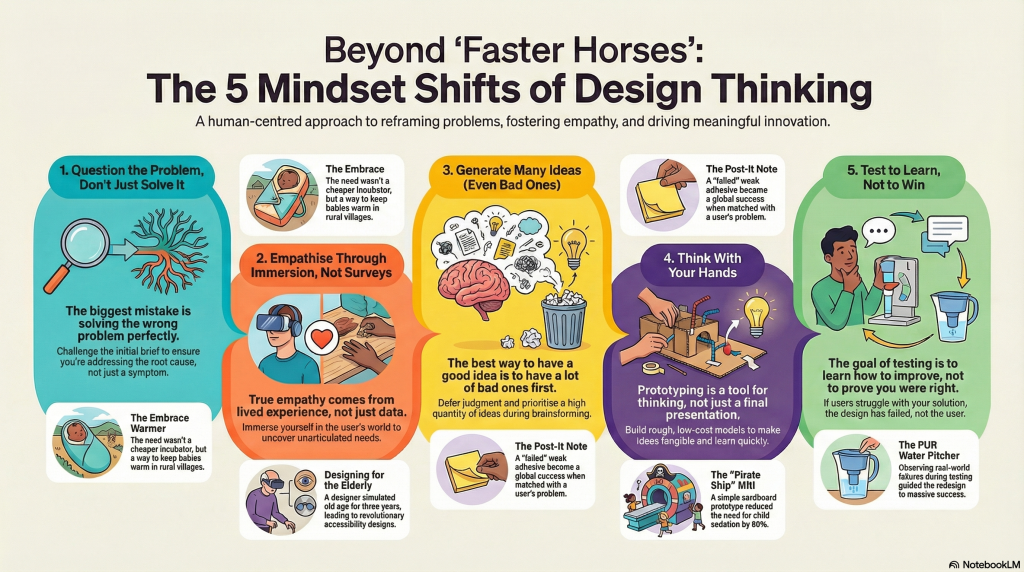
1. Start by Questioning the Problem, Not Solving It
The most common mistake in innovation is falling in love with a solution before fully understanding the problem. Traditional approaches take the initial problem statement as a given and dive straight into brainstorming answers. Design Thinking does the opposite: it starts by challenging the problem itself.
This was the key for Embrace Innovations. A team of Stanford students was initially tasked with a seemingly clear challenge: “design a low-cost incubator” for premature babies in developing countries. The logical path was to engineer a cheaper version of the $20,000 machines found in hospitals.
But after traveling to Nepal and India for empathy work, they discovered the initial problem was wrong. The issue wasn’t a lack of incubators in hospitals; it was that most premature babies were born in rural villages and never made it to a hospital in the first place. The real problem was helping these babies survive without reliable electricity or medical facilities. This principle is perfectly captured in Henry Ford’s famous, if perhaps apocryphal, statement:
“If I had asked people what they wanted, they would have said faster horses.”
This is the ‘faster horses’ problem in action. Had the team simply asked what was needed, they might have been told ‘a cheaper incubator’—a faster horse—instead of discovering the real need. This critical reframing led them away from a cheap incubator and toward the Embrace Warmer—a $200, sleeping bag-like device that maintains a baby’s temperature for hours. To date, it has helped over 300,000 vulnerable babies.
By questioning the problem, the team avoided beautifully solving the wrong one. This principle isn’t about being difficult; it’s about strategic clarity. It ensures that our most brilliant work is directed at a challenge that truly matters, preventing the immense waste of solving symptoms instead of root causes.
2. Empathy Isn’t a Survey, It’s an Immersion
In business, “empathy” is often confused with market research, surveys, and focus groups. In Design Thinking, empathy is a far deeper, more immersive practice. It’s about setting aside your own assumptions to understand another person’s world, emotions, and motivations from their perspective.
Industrial designer Patricia Moore took this to an extreme. To understand the challenges of the elderly, she transformed herself into an 85-year-old woman for three years. Wearing foggy glasses to simulate cataracts and binding her joints to restrict movement, she experienced firsthand the daily struggles of navigating a world not designed for her. Her insights led to revolutionary designs like lever door handles and rubber-grip kitchen tools—innovations born not from data, but from lived experience.
Conversely, a lack of deep empathy can lead to spectacular failure. Google Glass was a technological marvel, but it was a social failure. Its creators, focused on the technology, failed to fully grasp how wearing a face computer would make other people feel, leading to a product that was seen as socially tone-deaf and intrusive.
Immersive empathy is the antidote to building solutions in a vacuum. It uncovers the unarticulated needs that people can’t tell you about in a survey because those needs are woven into the fabric of their lives. It ensures that what we create doesn’t just work in theory but fits into the real, messy, and beautiful context of human existence.
3. The Best Way to Have a Good Idea Is to Have a Lot of Bad Ones
Our brains are trained to seek the “right” answer. We learn to filter, judge, and discard ideas that seem impractical or silly. Design Thinking demands we turn this instinct off, at least temporarily. During the ideation phase, the goal is to generate a massive quantity of ideas, deferring all judgment about their quality.
The story of the Post-It Note is a perfect example. In 1968, 3M scientist Spencer Silver accidentally created a “failed” adhesive—it was weak and repositionable. For six years, it was an invention without a purpose. A few years later, another 3M scientist, Art Fry, was frustrated that the bookmarks in his church hymnal kept falling out. He connected his problem to Silver’s “failed” adhesive, and the Post-It Note was born.
The ideation phase of Design Thinking deliberately encourages “wild ideas” and celebrates quantity over quality. This approach works because it liberates teams from the pressure of being right on the first try. It reframes failure not as an endpoint, but as a necessary and productive input for the creative process. The most groundbreaking solutions are often hidden within ideas that initially seem absurd.
4. Think With Your Hands, Not Just Your Head
In most fields, we are taught to think, plan, and perfect an idea before we start building. Design Thinking flips this script. Prototyping is not the final step to create a polished mini-product; it is a core part of the thinking process itself. It’s about making ideas tangible to learn from them quickly and cheaply.
This is the philosophy of “Start Ugly.” When GE designer Doug Dietz set out to improve the terrifying MRI experience for children, he didn’t start with expensive mockups. His first prototypes were built from cardboard boxes, his daughter’s toys, and markers. He turned the scanner into a “pirate ship adventure” using simple, rough materials. Yet, when he tested this ugly prototype with children, it worked. They saw an adventure, not cardboard. The results were astonishing: the redesigned experience reduced the need for sedation in pediatric patients by 80%.
Prototyping isn’t about building a product; it’s about building knowledge. It is the cheapest, fastest way to de-risk an idea, transforming “what if” from a high-stakes gamble into a low-cost experiment. This hands-on, low-fidelity approach makes abstract concepts concrete and allows teams to learn, discard, and change direction before any significant resources are invested.
5. Fall in Love With Learning, Not Your Solution
After investing time and creativity into a prototype, it’s natural to want it to succeed. But in the “Test” phase of Design Thinking, the goal is not to validate your idea; it’s to learn how it can be better. This requires a profound mindset shift toward humility and curiosity.
A team at Procter & Gamble learned this the hard way with their PUR Water Pitcher. The prototype was a feat of engineering that performed perfectly in the lab. They were confident they had a winner. But when they tested it with real families, it was a disaster.
The list of failures was long: it was too tall to fit on a standard refrigerator shelf, and the filter replacement indicator was completely confusing. The team’s most profound insight came not from a question, but from observation: they watched a grandmother use salad tongs to retrieve the pitcher from a low shelf, revealing just how poorly the handle was placed. Instead of blaming “user error,” the team embraced every failure as a critical insight. For eighteen months, through hundreds of tests, they let these real-world struggles guide the redesign, which ultimately became a massive commercial success.
This story highlights the most important mindset in testing. True innovation comes from a willingness to see your “perfect” solution fail and the humility to let the people you’re designing for show you how to make it right. As the source text aptly states: if users struggle, the design has failed, not the user.
What Problem Will You Reimagine?
These principles are not isolated tactics; they are interconnected parts of a single mindset. It’s a mindset that finds clarity not in boardrooms but in villages, that seeks breakthroughs not in genius but in volume, and that discovers truth not in arguments but in cardboard and tape. This approach isn’t just for designers—it’s a powerful tool for anyone looking to create meaningful change in any field.
